
The Causemakers Blog

How to Calm Racing Thoughts: Fast Relief and Lasting Change
To calm racing thoughts, work on your body first and your thoughts second: slow your breath, anchor your senses in the room, and move. Then deal with what keeps the loop running, which is usually a nervous system stuck on high alert. This guide gives you the tools that work in the next five minutes and explains how to change the pattern underneath, so you are not fighting the same battle every night. At The Causemakers, we build our work on that second part.
If you are a high achiever, a parent trying to stop an inherited pattern, or someone who has understood your thoughts perfectly well in therapy and still cannot switch them off, the order matters. Insight tells you why the mind races. It does not always tell your body it is safe to stop.
TL;DR
- Racing thoughts are most often driven by anxiety and a body that stays on alert, so start with breathing, grounding or movement before you try to reason with the thoughts.
- Three fast tools: breathe in for 4, hold for 4, out for 6 (10 rounds); the 5-4-3-2-1 grounding exercise; or a five-minute walk.
- To stop the nightly replay, schedule 10 to 20 minutes of worry time earlier in the day and write your to-do list down before bed.
- If the thoughts keep returning, the lasting work is with the nervous system and the identity underneath the pattern, which is what our Embodied Identity Method is designed for.
- If the thoughts are very fast, you need far less sleep than usual, or you feel unlike yourself, speak to a doctor.
Table of Contents
- Why your mind races
- Calm racing thoughts in the next five minutes
- Quiet racing thoughts at night
- Habits that keep racing thoughts from coming back
- When the thoughts keep coming back, look at the pattern
- Where to start with us
- When to talk to a doctor
- How to tell whether a technique is working
- FAQ
- Sources
Why your mind races
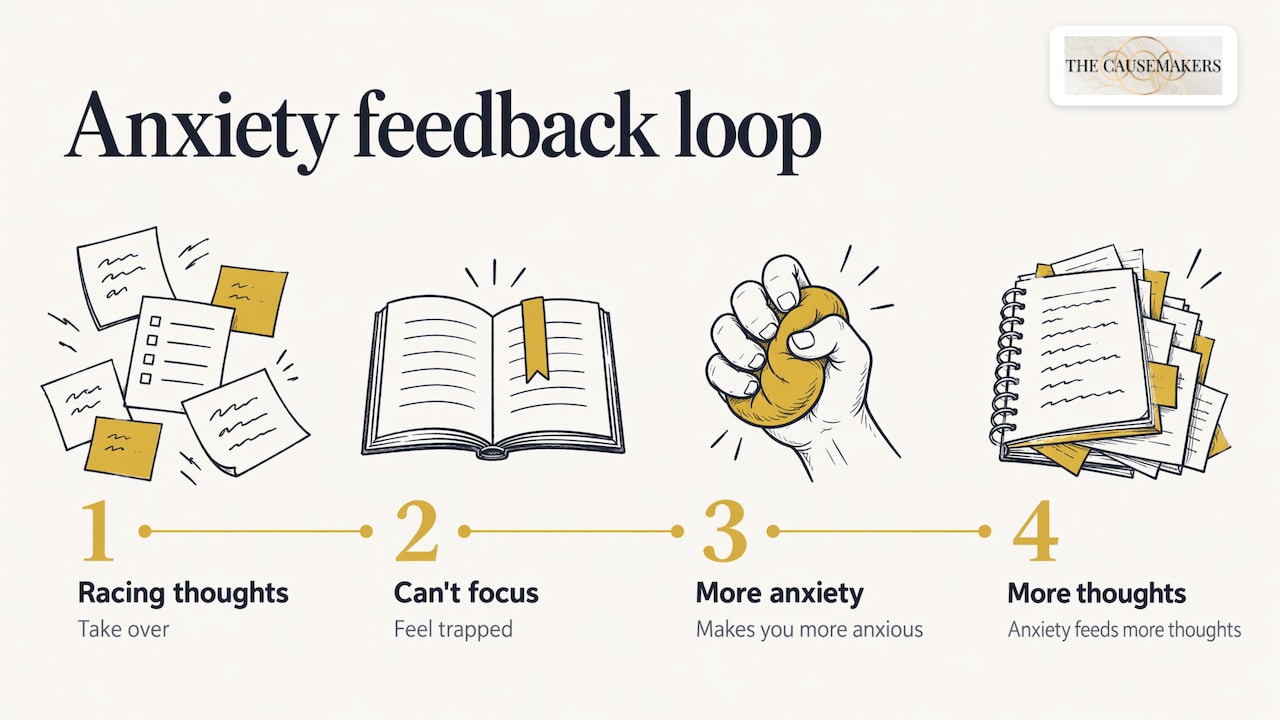
A racing mind is not a character flaw. Harvard Health names anxiety as the most common cause: you cycle through what needs doing, what has not been done and what comes next. Once the thoughts take over, you feel trapped and unable to focus, and that makes you more anxious, which feeds more thoughts.
Two mechanisms keep the loop going. Johns Hopkins Aramco Healthcare describes rumination, where the brain replays unresolved thoughts, and attention residue, where unfinished tasks keep part of your mind attached to them. Both hold the brain in a heightened state of alert even when you want to rest.
The same source lists conditions that can make a mind harder to slow down: anxiety disorders, ADHD, insomnia, depression, an overactive thyroid, chronic stress and heavy caffeine use. Racing thoughts can also be a sign of a manic or hypomanic episode in bipolar disorder, according to a psychiatrist at Talkiatry, often together with elevated mood, impulsivity, fast speech and less need for sleep. We come back to that in the section on when to get help.
Why it gets worse when you are successful and tired
High achievers tend to carry long mental lists and a habit of staying useful every waking minute. Every unfinished item is a piece of attention that never fully closes. Add chronic stress and a nervous system trained early to stay vigilant, and the mind never gets the signal that the day is over. That is the pattern the rest of this guide addresses, first with tools, then with the root.
Calm racing thoughts in the next five minutes
The aim of these techniques is not to win an argument with your thoughts. It is to lower your physical arousal and give your attention somewhere else to land. Pick one, do it fully for a few minutes, and see what shifts.
1. Slow your breath with a longer exhale
The American Psychological Association recommends breathing in for four counts, holding for four and breathing out for six, repeated 10 times. Slowing the breath lets the body recalibrate and lowers physiological arousal. The longer exhale is the point: do not rush it.
Where it goes wrong: people breathe in deeply and fast, which can feel like more activation. Keep the inhale gentle and let the exhale do the work. If holding your breath feels uncomfortable, shorten the hold.
2. Count your breaths
Harvard Health describes a simple mindfulness exercise: close your eyes, count one on the inhale and two on the exhale, up to 10, then start over until you settle. Its advice is to practice at times when your thoughts are not racing, so the skill is ready when you need it. Two minutes while the kettle boils is enough to build the habit.
3. Ground yourself with 5-4-3-2-1
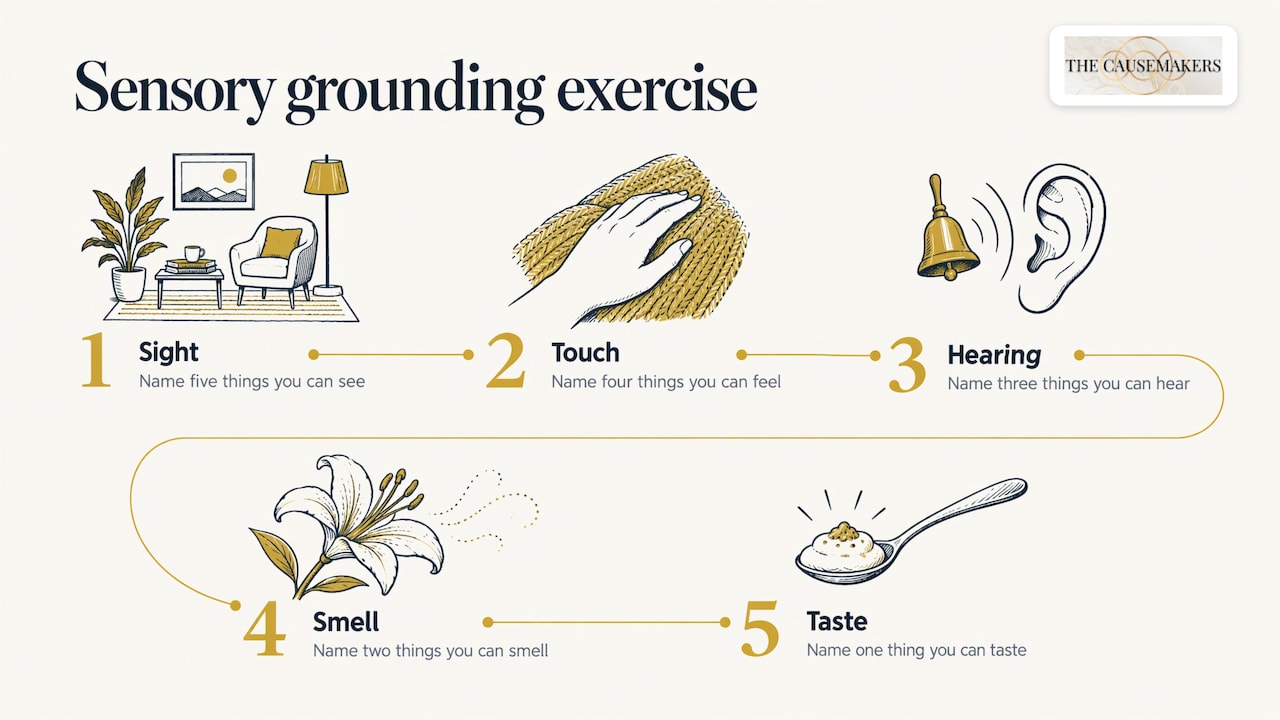
Name five things you can see, four you can feel, three you can hear, two you can smell and one you can taste. Cleveland Clinic explains that worry usually points at the future or the past, so this exercise pulls attention into the present moment. It works best when practiced regularly and is most helpful when used early, as soon as you notice the spiral starting. The more you practice, the more your nervous system learns to move into a calmer state, and even a few minutes a day helps.
4. Use the STOP technique
A UK mental health service, MindWell Leeds, describes a short sequence for spiraling thoughts:
- Say “stop” to yourself.
- Breathe out slowly and fully.
- Drop your shoulders and unclench your hands.
- Count slowly from five down to one.
- Pause before deciding what to do next.
Repeat as needed. The physical release in step three matters: many people discover their jaw, hands or shoulders have been braced for hours.
5. Move your body
Harvard Health suggests a set of push-ups, 10 jumping jacks, a five-minute walk or household chores when an episode strikes. Movement breaks the cycle and gives the mind something else to focus on. It also recommends building regular exercise into your life to relieve anxiety and stress.
6. Count backward by threes
The APA also suggests counting backward from 100 by threes. The task is structured enough to occupy the part of the mind that is looping. It is a good choice in a meeting or on a train, where closing your eyes to breathe is not practical.
Which one to choose
| Situation | Try first |
|---|---|
| At your desk or in public | Counting backward by threes, or 5-4-3-2-1 |
| Lying in bed | 4-4-6 breathing or breath counting |
| Body buzzing with adrenaline | A five-minute walk or jumping jacks |
| Spiral has just started | STOP, then 5-4-3-2-1 (early is best) |
Quiet racing thoughts at night
Nights are harder for a reason. Mental Health 360 explains that during the day, work, conversations and tasks compete for attention. At bedtime the distractions disappear, so worries you pushed into the background suddenly feel much louder, and stress keeps the mind alert even when the body is tired.
Close the day before you get into bed
The American Academy of Sleep Medicine quotes sleep specialist Dr. Ralph Downey III saying that taking your mental to-do list to bed makes the mind race or rehearse the next day. His advice is to make the list early in the evening and put it away for a sense of closure. Australian National University’s sleep guidance adds a useful twist: write a brief next step beside each worry, so at bedtime you can remind yourself that you have already thought it through and will handle it tomorrow.
Build a wind-down
Cleveland Clinic recommends a screen-free buffer of 30 to 60 minutes before bed. Screens are stimulating and their light delays melatonin release, and the buffer works as a cue to the brain that bedtime is coming. The same article suggests a 15-minute worry journal in the early evening, gratitude journaling before bed and progressive muscle relaxation from the toes up to the shoulders.
The ANU guidance also advises avoiding caffeine in the 5 to 7 hours before bedtime, because it stays in your system a long time. For a high achiever running on afternoon coffee, this one change can be significant.
If you are still awake after 20 minutes
Dr. Downey describes a “20/20” approach: if you lie in bed about 20 minutes without sleeping, get up, go to a dimly lit, comfortable room with no distractions, and return after about 20 minutes, repeating no more than two or three times a night. He also calls the belief that lying there long enough guarantees sleep a bad idea. Mental Health 360 gives the same reasoning: doing something quiet and relaxing until you feel sleepy teaches the brain that bed means rest, not hours of worrying about sleep.
Habits that keep racing thoughts from coming back
Techniques calm an episode. Habits lower how often one starts.
Schedule worry time
Harvard Health’s version is simple. When a racing thought arrives, tell yourself that now is not worry time. At a fixed time you choose, spend 10 to 20 minutes exploring those thoughts, writing them down without editing, worst cases included. Then move on. The NHS Every Mind Matters guidance in the UK offers a similar idea: set aside 10 or 15 minutes, for example before bed, to write worries down and look for solutions.
Where it goes wrong: choosing worry time late at night, or letting it run past the limit. Early evening works better, and a timer keeps it honest.
Practice when you are calm
Both Harvard Health and Cleveland Clinic make the same point: these skills work better when rehearsed on ordinary days. Treat your breathing or grounding practice like a short daily workout, not a fire extinguisher you only reach for in an emergency.
Track your triggers
Michael Roman, MD, at Talkiatry advises noticing whether racing thoughts show up during stressful periods or seemingly out of nowhere, and tracking any accompanying symptoms. A two-line note each day is enough. The pattern you find is useful for you and for any professional you later talk to.
When the thoughts keep coming back, look at the pattern
Here is the situation we hear most from people who read articles like this one: the tools help for an evening, then the mind races again. If you have done therapy, understood where the pattern comes from, and still lie awake rehearsing, the tools are not failing you. They are working at the level of the moment, and the pattern lives deeper.
Racing thoughts are often what a nervous system sounds like when it has learned that staying alert is the safe thing to do. For many people that learning started early: a household where you had to read the room, a parent who was anxious, a pattern handed down through generations. Telling that nervous system to relax rarely works. Showing it, through the body, that it is safe tends to go further.
This is the premise of the Embodied Identity Method™, developed by our founder Louise Mieko Chapman. It combines identity and self-concept work with nervous-system-focused, embodied approaches, including somatic therapy, hypnotherapy and breathwork, rather than relying on insight or talk alone. It is designed for people who have struggled with conventional methods, and for parents who want to stop negative cycles from passing to their children.
The breathing and grounding exercises above are small versions of the same idea: change the body’s state and the thoughts follow. Working with that principle at greater depth, and on the identity beliefs that drive the vigilance, is what the method is built around.
Where to start with us
The simplest first step is our free nervous-system assessment, the Clarity Assessment, which you can reach from The Causemakers. It gives you a clearer picture of how your nervous system is responding before you commit to anything.

If you are ready for deeper work, the 8-week Embodied Identity™ Immersion is 4,444 AUD one-off. The same page lists ongoing options: bi-weekly group coaching and attunement sessions at $297 per month, and individual weekly coaching at $2,222 per month. If you prefer to begin on your own, our book and video course, both called You Are the Cause, are on the You Are the Cause page.
When to talk to a doctor
Coaching and self-help tools are not a substitute for medical care, and some signs need a clinician. Speak to your doctor or a mental health professional if:
- Racing thoughts regularly affect your life or your sleep. Harvard Health notes that frequent racing thoughts may be linked to anxiety disorders, ADHD, OCD, trauma or other conditions that deserve proper assessment.
- Your thoughts feel so fast you cannot follow them, you are sleeping very little but do not feel tired, or you feel unusually high, impulsive or unlike yourself. Mental Health 360 lists these as reasons to see a doctor, and they overlap with the hypomanic and manic signs described earlier.
- The racing began after you started a new medicine, or you are using alcohol or drugs to slow your mind down. Tell your doctor this.
- Night-time thoughts include distressing memories or nightmares about something that happened to you.
- You are losing hours of sleep most nights or feel fatigued all day. Cleveland Clinic says this can point to an anxiety disorder or insomnia, and suggests a behavioral sleep medicine psychologist if anxiety mainly disrupts sleep, or a psychologist specializing in anxiety if the thoughts run all day too.
A UK physician quoted by the WPA notes that cognitive behavioral therapy (CBT) is the recommended first-line treatment for both anxiety and insomnia. If you are thinking of harming yourself or feel in danger, call your local emergency number or go to the nearest emergency department right away.
How to tell whether a technique is working
Cleveland Clinic’s guidance gives you a practical frame: grounding works best with regular practice, and best of all when you use it as soon as you notice the first signs. So judge a technique by three things over two weeks.
- Speed. Do you catch the spiral earlier than you used to?
- Recovery time. Do episodes end sooner, even if they still start?
- Frequency. Are there fewer nights where the mind takes over?
If one technique does nothing, swap it rather than push harder. Breathing helps some people and makes others more aware of tension, in which case movement or counting tasks often suit better. If none of them change the picture and your anxiety is hard to manage or interferes with daily life, Cleveland Clinic advises talking with a healthcare provider or mental health professional about treatment options.
When the tools help in the moment but the same thoughts return week after week, that is useful information. It suggests the work now is the deeper pattern, and that is where the Embodied Identity Method comes in.
FAQ
What is the fastest way to stop racing thoughts?
Slow your exhale. Breathe in for four, hold for four and out for six, ten times, as the American Psychological Association recommends. If your body feels wired, a five-minute walk or a set of jumping jacks can break the loop even faster.
Why is my mind racing at night when I am exhausted?
At bedtime, the tasks and conversations that occupied you all day disappear, so background worries feel louder, and stress keeps the mind alert even when the body is tired. Writing your to-do list early in the evening and keeping a screen-free wind-down give the mind a clear signal that the day is done.
Is it normal to have racing thoughts every day?
Occasional racing thoughts are common, especially under stress. If they happen regularly, interfere with sleep or concentration, or come with symptoms like very little need for sleep or unusually high energy, see a doctor or mental health professional to find out what is behind them.
Can racing thoughts be linked to trauma or inherited patterns?
Yes. Harvard Health lists trauma among the issues that frequent racing thoughts may be related to. When the mind races because the nervous system learned to stay on guard, working with the body and identity, as our Embodied Identity Method does, addresses the pattern rather than only the symptom.
Sources
- Slowing down racing thoughts, Harvard Health
- Racing Thoughts: How to Calm an Overactive Mind, Johns Hopkins Aramco Healthcare
- Racing Thoughts: How they Relate to Anxiety, Bipolar, and more, Talkiatry
- Stress management tools, American Psychological Association
- 5-4-3-2-1 Grounding for Anxiety, Cleveland Clinic
- Find ways to calm or distract yourself, MindWell Leeds
- Why Can’t I Switch My Brain Off at Night?, Mental Health 360
- Managing Racing Thoughts, Mental Health 360
- Don’t Allow a To-Do List to Cut into Your Sleep Time, American Academy of Sleep Medicine
- Sleeping well, Australian National University
- How To Stop Your Mind from Racing and Get To Sleep, Cleveland Clinic
- Tackling your worries, NHS Every Mind Matters
- How to break the cycle of anxiety and poor sleep, WPA
Recommended


- FREE DOWNLOAD -
Teleporting to the Future Subconscious Reset
Stop wasting your time with outdated approaches to achieving your goals. This FREE Teleporting to the Future Subconscious Reset will show you neuroscience backed strategies for avoiding feeling stuck and manifesting your goals faster without burnout.
What Some Of My Amazing Clients Have To Say...

"Louise's gentle nature supported me to be vulnerable and she facilitated a lovely healing experience which led to releasing some deep karmic wounds. Thankyou!"
Ciara Parisi

"Louise guided me through a hypnotherapy session which helped me to forgive my father and release a block I had in my love life, and gave me the tools to feel calm and in control when life gets chaotic"
Natasha R

"I had self sabotage patterns that threatened to ruin my marriage and Louise helped me to release the trauma behind them so my marriage is now thriving"
Andy Hastings
Info
Connect with me
Connect with me on social media as that is where I share my most recent updates.



Copyright 2026. The Causemakers. All rights reserved.
Proudly Powered by CoachMatic.app